With the spiralling cost of electricity starting to bite last year, we made the decision to look into the cost of fitting solar panels to our house.
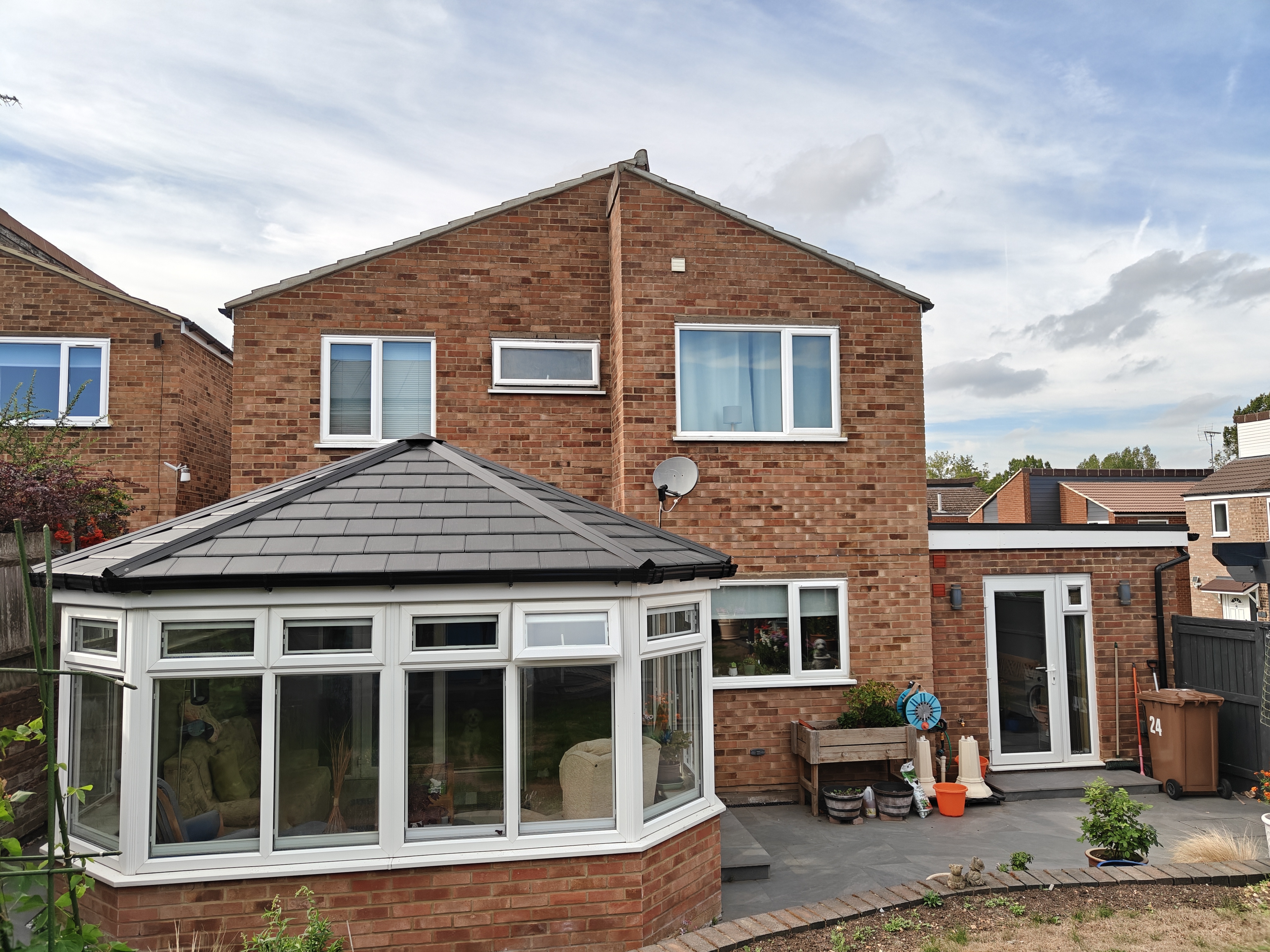
We started to get some quotes, but a decision we had to make early on was whether to fit panels to all the roof space or just to the south facing roof. Our house is located in Stevenage, about 25 miles north of London, and the roof is positioned such that one side faces south (well close to south - a compass bearing of about 190deg) and the other north (about 10 deg). Conventional wisdom said that it’s not worth fitting panels on the north side because they won’t generate much power. However, when I did research prior to having the panels fitted, the most common advice from people who already had solar fitted was, ‘Fit as many as your roof space will take’. I read nothing from anyone who had solar installed and said, ‘I wish we hadn’t fitted as many panels’.
So when we got quotes we specified that both sides of the house should have panels. In fact, because we have a boiler flue that exits the roof on the north side, there was less usable space on that side, and in the end we had a total of 22 panels fitted, split 8 on the north and 14 on the south. However, the design of the house is such that the roof surfaces are at quite a low pitch angle of about 30 degrees.
Installation
The installation took place in May 2025 and consisted of 22 REA-HD108N 450W bifacial panels each fitted with Enphase micro inverters, an AlphaESS 5kW inverter and 16kWh battery. The work was carried out by Heatable and we were very pleased with the quality of the work and speed with which they got everything completed.
During the first summer of being ‘Solar installed’, we were thrilled that we were completely independent of the grid supply. I don’t mean of course that we were disconnected, but we didn’t have to import any electricity from the day after the install took place on 9th May until the last day of September 2025. By that time the days were getting shorter and I set up a regular charge from the grid overnight to charge the battery and we could basically only have to use night rate electricity from then on. Overall, our monthly charge went from close to £300 down to £140 a month (this includes the charge for gas and the standing charge).
So overall we were very happy with the decision, but I was interested to know how much power the panels on the north side of the house were supplying compared to the south, so during those first few months I kept a close eye on the Enphase app that shows the array and the power produced by each panel. And that’s when I noticed something interesting - it seemed to me that on dull days, the north side panels were producing almost the same amount of power as the south side panels.
Look at the Data
I wanted to confirm this with real data rather than just rely on my gut feeling, so a few days ago I started to get the historic data together to find out just how much truth there was in this theory.
Fortunately, I had connected my Home Assistant server to the EnPhase system as soon as we had the installation, and looking at Home Assistant I found that each of the 22 microinvertors had been logging their power generation every 60 minutes since install, and all of that data had been safely stored away just waiting for me to look at it.
Because of the size of the data, I got some assistance at this point to do some analysis for me, so the charts and tables that follow were generated with the help of ChatGPT, but they are based on the actual Home Assistant production history together with historical weather and solar-radiation data from Open-Meteo.
So, how much power did the north-east roof actually generate?
For a fair annual comparison I used the first complete 12 months of data, from 10 May 2025 to 10 May 2026.
During that period:
| South Facing Panels | North Facing Panels | |
| Total generation | 6,400 kWh | 2,355 kWh |
| Panels | 14 | 8 |
| Generation per panel | 457 kWh | 294 kWh |
On a per-panel basis, the north facing roof panels produced about 64% as much electricity as the south facing roof panels over the year, which surprised me. Although that is obviously significantly less than putting the same panels on the south facing roof, it is also much more generation than I expected, and certainly more than anyone who would suggest fitting north facing panels was a ‘waste of money’ would expect.
The graph showing the generation for each side of the roof (for the full installation period) is shown here.
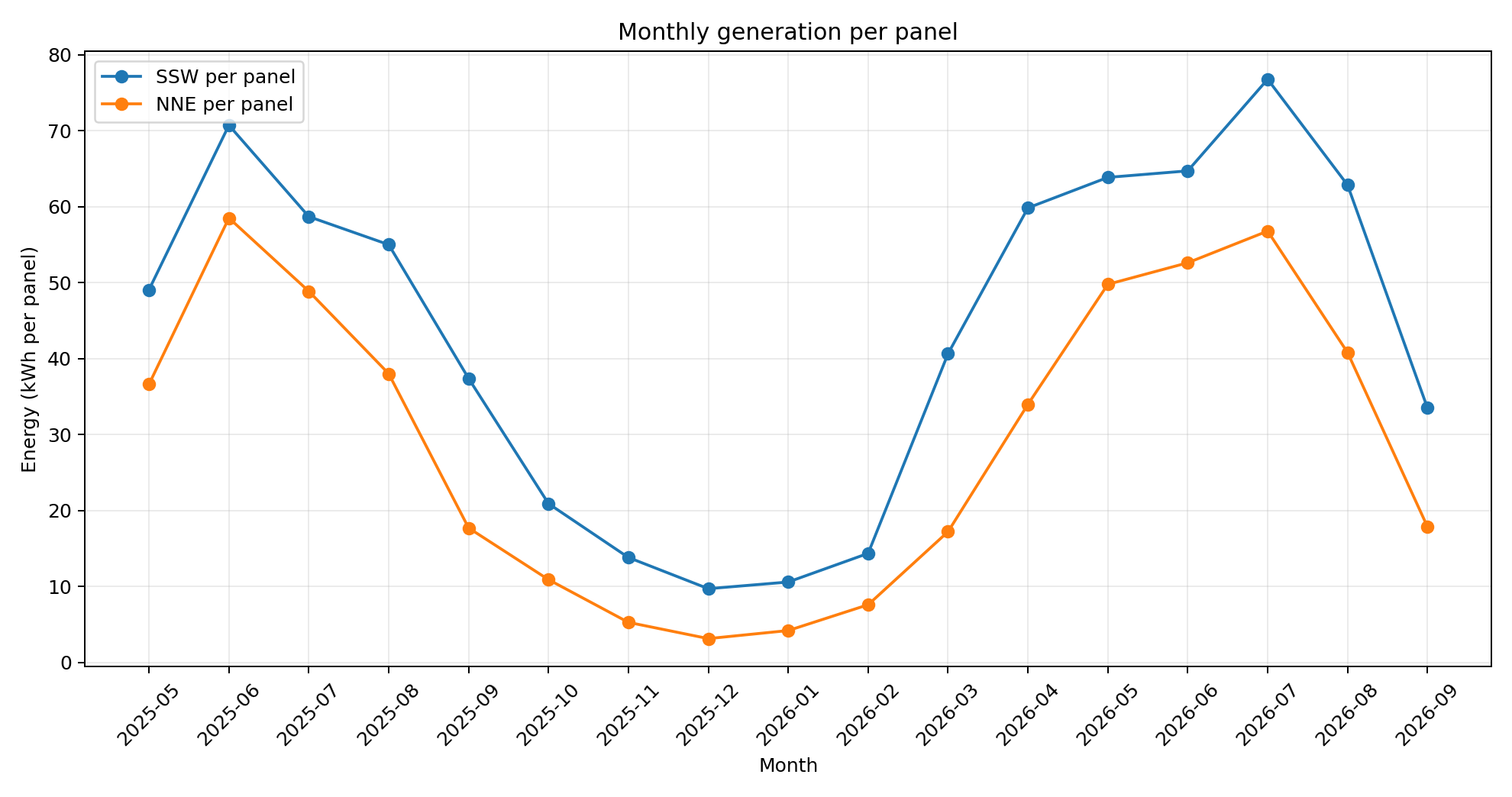
This is interesting, but it didn’t answer my hunch that the north roof panels were particularly beneficial during cloudy weather. For that I needed to compare the power each panel produced on days when the sky was cloudy, so I needed a source of historical weather information.
Fortunately, that information is available using a site called Open-Meteo and can be extracted for free using simple api calls.
I wrote a simple script to pull that data, supplying my house location, the direction of the solar panels and the roof pitch, and with this information and further help from ChatGPT, I was able to get some real data as to the amount of power each panel was producing on each day of the year, and use the weather data to separate cloudy days from sunny days.
The result was quite interesting and is shown in the table below where I’ve shown the percentage of power the north facing panels produced compared to the south facing panels split into 5 levels of diffuse fraction. To explain, the weather data I obtained supplied numbers for
- shortwave_radiation - which is essentially the total solar radiation on a horizontal surface and
- diffuse_radiation - which the part of that radiation arriving as scattered/diffuse light
The diffuse fraction is diffuse_radiation divided by shortwave_radiation but really it can be seen as a measure of the total amount of light scattering - or how much the clouds have scattered the light.
By dividing the days up in to 5 buckets of typical diffuse fraction the I got these results
| Typical diffuse fraction | NNE output per panel as % of SSW |
|---|---|
| 19% | 61% |
| 32% | 61% |
| 44% | 74% |
| 60% | 79% |
| 89% | 94% |
On the most diffuse fifth of days, when roughly nine-tenths of the available solar radiation was diffuse, a north-facing panel typically produced around 94% as much as a south-facing panel.The simplest way of viewing this is that on days when most of the available solar radiation was diffuse - typically in heavily overcast conditions - the north-facing panels were producing almost as much per panel as the south-facing panels.
So are North facing panels better in the Winter?
This got me thinking - since it's more cloudy in the winter than in the summer, perhaps the north facing panels will be more beneficial in the winter time - perhaps that's the time they will really come into their own and provide the maximum amount of power. So I asked ChatGPT to do that analysis and provide me with the figures for the split in power generation over the winter months.
To my surprise, although the figures showed that on very cloudy days in the winter the north facing panels were producing close to the amount of power as the south facing panels, the south panels were still providing the majority of the power during the winter. The reason for this is that the sun is so low in the sky during the dark winter months, that very little of the radiation is getting to the north facing panels when the sky is clear.
So was it worth getting Solar Panels fitted to the North facing side of our house?
My conclusion has been that it has been worth it for us. The additional cost of those 8 panels was approximately £3000 which was about £2000 for the additional panels themselves and then another £950 for the extra scaffolding. But there have been several positive outcomes from having the extra production those panels have given:
-
The NNE roof is making quite a substantial contribution. Over the first complete year, each north-facing panel produced about 64% as much energy as each SSW panel.
-
The north roof is much more competitive under cloudy, overcast conditions. On the most diffuse days, NNE output per panel rose to around 90%+ of the SSW output, and in the most overcast winter subset it was close to parity.
- We get power generated much earlier in the day because of those extra panels. On clear days, the NNE roof starts contributing earlier in the morning. Across clear days, NNE panels produced about 2.3× as much per panel as SSW between 5:00 am and 8:00 am, and about 1.5× as much between 5:00am and 9:00am.
-
Even though the South facing roof produces the most power, the North side is still useful and its production is adding useful power on top of the south side.
- About £3,000 extra bought roughly 2.35 MWh/year of additional generation in the first full year, rather than requiring a completely separate solar installation.
-
The usual “don’t put panels on a north-facing roof” rule is too simplistic. Our data doesn’t show that north-facing panels are ideal, but it does show that on a shallow UK roof they can produce a surprisingly useful amount of energy, especially when added economically to an installation that is already going ahead.
-
The strongest article conclusion is probably not “north-facing panels work well in winter.” A better formulation is: north-facing panels lose much of their disadvantage when the available light is diffuse, while also extending generation earlier into the morning on clear days.
One other thought for anyone faced with the situation where they can only put panels on the north side of their property or the north side has the largest area. A few years ago it was common for solar panels to be rated at 250W. The panels we had fitted are 450W and are the same physical size as those 250W panels and I've no doubt that in a few years time it will be possible to get panels the same size that will be rated at 600, 700 or even 800W. The time is coming when even north facing panels will be producing enough power to make the move to solar worthwhile.